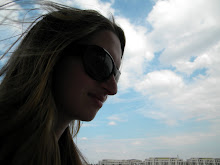
One day I hope
I will be able to show you
why
I am alive.
The difficulty is thick,
clods of dirty ice
I long to smash from our hearts.
Mostly
I do not understand it myself.
And then it bursts upon me like April!
in a single moment which cloisters itself
in my breast.
- a deep and timid secret, it fearfully hates
the callous human intercourse -
It is like being stabbed,
as the hot blood rushes to my face
and pools in my chest.
The small upturned face asks,
"Why are you beautiful?"
And I want to cry:
I am too weak to say,
"Because I love you."
(Cupping your cold heart,
I gently part my lips
and breathe softly,
until I weep with exhaustion.)
Monday, March 9, 2009

Tuesday, January 13, 2009
Rejection
Standing outside the club, I handed the security guard my driver's license. She handed it back to me, saying, "Den kann ich nicht akzeptieren." I asked "Warum nicht? Mein Geburtstagsdatum steht schon d'rauf. Ich bin 21! Lassen Sie mich rein!"
She responded only more cooly, "Ich kann nur deutsche Ausweise akzeptieren."
Suddenly I had everyone's attention. People stopped dancing to crowd around the entrance of the club, trying to look at me, wanting desperately to hear what I had to say. People on the street stook awestruck as I began to shout -
"I know - Ich weiss dass ich keine Deutsche bin! Ich bin nur diese einsame, alleine Amerikanerin, und du - " I began to sob and scream - "DU! Du hast mich nicht angenommen, nicht hereingelassen!"
I took a deep breath. Now I would tell them. And they were all listening. I would make them understand, in a grand soliloquy, the depth of my loneliness. Then, they would fall into madness and exalt me as a goddess.
Opening my mouth to begin, rejection became something from which I did not want to repent. So my soliloquy became a choked cry, as I ran outside and disappeared into the black shadow of the Cathedral in front of me.
She responded only more cooly, "Ich kann nur deutsche Ausweise akzeptieren."
Suddenly I had everyone's attention. People stopped dancing to crowd around the entrance of the club, trying to look at me, wanting desperately to hear what I had to say. People on the street stook awestruck as I began to shout -
"I know - Ich weiss dass ich keine Deutsche bin! Ich bin nur diese einsame, alleine Amerikanerin, und du - " I began to sob and scream - "DU! Du hast mich nicht angenommen, nicht hereingelassen!"
I took a deep breath. Now I would tell them. And they were all listening. I would make them understand, in a grand soliloquy, the depth of my loneliness. Then, they would fall into madness and exalt me as a goddess.
Opening my mouth to begin, rejection became something from which I did not want to repent. So my soliloquy became a choked cry, as I ran outside and disappeared into the black shadow of the Cathedral in front of me.
Monday, November 24, 2008
Thoughts on Sarajevo - 11/8/08
I was cleaning my desk and found this scrap of paper, where I had scrawled the following during the train trip described in the previous post:
Sarajevo turned out to be a very interesting city, beautiful, sad, hopeful and unforgettable, and I am glad to have visited it. One the one hand, it reminded me of Ecuador, with its trash-lined streets, the grayness of its buildings where people's private lives hang in the open windows, and the vendors haggling in the streets and watching over their wares everyday for endless hours. But the grayness of cities has many sources.
Unlike in Ecuador, the face of war still hangs grimacing over Sarajevo. Some buildings have been entirely rebuilt, but most are still riddled with bullet holes and shrapnel marks. The post-war standard seems to be, "repair it to usefulness; attractiveness can come later." So, windows have been replaced and doors rebuilt, but everything else remains as it was when the shooting stopped 13 years ago.
Buildings deemed beyond repair have not been torn down, but stand as empty, ruinous reminders of a time when death lurked in every corner. The people of Bosnia have no need yet for post hoc memorials - the streets themselves, covered in shrapnel scars, remind everyone of what went before. Gaping windows tell us of a life lost. And even if you might begin to forget, the graffiti sprayed on every gray wall will tell you of your sin.
Sarajevo turned out to be a very interesting city, beautiful, sad, hopeful and unforgettable, and I am glad to have visited it. One the one hand, it reminded me of Ecuador, with its trash-lined streets, the grayness of its buildings where people's private lives hang in the open windows, and the vendors haggling in the streets and watching over their wares everyday for endless hours. But the grayness of cities has many sources.
Unlike in Ecuador, the face of war still hangs grimacing over Sarajevo. Some buildings have been entirely rebuilt, but most are still riddled with bullet holes and shrapnel marks. The post-war standard seems to be, "repair it to usefulness; attractiveness can come later." So, windows have been replaced and doors rebuilt, but everything else remains as it was when the shooting stopped 13 years ago.
Buildings deemed beyond repair have not been torn down, but stand as empty, ruinous reminders of a time when death lurked in every corner. The people of Bosnia have no need yet for post hoc memorials - the streets themselves, covered in shrapnel scars, remind everyone of what went before. Gaping windows tell us of a life lost. And even if you might begin to forget, the graffiti sprayed on every gray wall will tell you of your sin.
Tuesday, November 11, 2008
A dream
I saunter out onto the tracks of the Stuttgart Hauptbahnhof, 20 minutes before my train is scheduled to leave. I stand in the cold, idly staring at the offerings of the platform's vending machine. Suddenly the conductor, a small blond woman, starts frantically yelling at me to get on the train; it's leaving right away. I confirm that it is indeed headed for Munich, and stagger aboard, bewildered. The car is almost empty. Besides me, there is only family of 3 - a mother, father and their son who can't be older than 4.
Despite the fact that we have departed 20 minutes ahead of schedule, the captain comes onto the loudspeaker at every stop to apologize for the delay. Could it be that I am on an earlier train that was severely delayed? Am I on the right train?
The trip drags on and on. We keep slowing to a crawl in the middle of nowhere, in complete darkness. The flash of a camera keeps glaring at me through a crack in the seats, as the mother seemingly is making a photo journal of her son's great Ride on the Train. He grows bored of sitting with his parents, and devises a game for himself. He divides his father's newspaper into sections, and carefully walks through the car, placing a piece of the newspaper in each empty row. Soon every row except mine has a piece of the newspaper. Then he goes back to every row and picks up the pieces of the paper, until he is holding the whole jumbled mess in his tiny arms. The process repeats endlessly, until they get off the train at Munich-Pasching. They leave behind 2 half filled Pepsi products and a few newspaper sections scattered randomly about the car. I collect these, and determine which might have reading value.
We get to Munich Hauptbahnhof about 11:20. The train for Ingosltadt doesn't leave until 12:30. I wander up and down the platform and soon bore of my newspaper sections. I leave them on an empty bench. When the train comes, I take shelter from the cold in it immediately, even though it won't leave for another half an hour. As soon as we depart, the captain comes onto the loudspeaker and says that the train has been rerouted. We will go around the entire south side of Munich before heading north to our first stop, adding half an hour to the journey. At 2 am, I finally get out at the Ingolstadt Hauptbahnhof.
A thick fog has descended over the city, and there are neither buses nor cabs. I start walking down the main street toward my apartment. It is about a 2 mile walk, and I can only see about 30 feet in any direction. Suddenly, a man in a suit comes running out of the fog toward me. He pauses when he sees me, but only long enough to say, "I'm being followed!" before he starts running again. I see a second man emerging at a half-trot from the fog, presumably the one following the first.
I dash across the street. The man passes in the opposite direction, and disappears behind me. I hear nothing of note.
About 2:30am, I am finally at my apartment door. All is as it should be.
*This series of dreamlike occurences was my actual trip home from the Stuttgart Hauptbahnhof after flying in from Sarajevo.*
Despite the fact that we have departed 20 minutes ahead of schedule, the captain comes onto the loudspeaker at every stop to apologize for the delay. Could it be that I am on an earlier train that was severely delayed? Am I on the right train?
The trip drags on and on. We keep slowing to a crawl in the middle of nowhere, in complete darkness. The flash of a camera keeps glaring at me through a crack in the seats, as the mother seemingly is making a photo journal of her son's great Ride on the Train. He grows bored of sitting with his parents, and devises a game for himself. He divides his father's newspaper into sections, and carefully walks through the car, placing a piece of the newspaper in each empty row. Soon every row except mine has a piece of the newspaper. Then he goes back to every row and picks up the pieces of the paper, until he is holding the whole jumbled mess in his tiny arms. The process repeats endlessly, until they get off the train at Munich-Pasching. They leave behind 2 half filled Pepsi products and a few newspaper sections scattered randomly about the car. I collect these, and determine which might have reading value.
We get to Munich Hauptbahnhof about 11:20. The train for Ingosltadt doesn't leave until 12:30. I wander up and down the platform and soon bore of my newspaper sections. I leave them on an empty bench. When the train comes, I take shelter from the cold in it immediately, even though it won't leave for another half an hour. As soon as we depart, the captain comes onto the loudspeaker and says that the train has been rerouted. We will go around the entire south side of Munich before heading north to our first stop, adding half an hour to the journey. At 2 am, I finally get out at the Ingolstadt Hauptbahnhof.
A thick fog has descended over the city, and there are neither buses nor cabs. I start walking down the main street toward my apartment. It is about a 2 mile walk, and I can only see about 30 feet in any direction. Suddenly, a man in a suit comes running out of the fog toward me. He pauses when he sees me, but only long enough to say, "I'm being followed!" before he starts running again. I see a second man emerging at a half-trot from the fog, presumably the one following the first.
I dash across the street. The man passes in the opposite direction, and disappears behind me. I hear nothing of note.
About 2:30am, I am finally at my apartment door. All is as it should be.
*This series of dreamlike occurences was my actual trip home from the Stuttgart Hauptbahnhof after flying in from Sarajevo.*
November
Come, small one
and gather your things:
We are unburdened now.
Let us leave this rain
to look for new rain,
and let fresh lies
bury our deceit.
Look out into the fields, and see!
How they are overturned,
and the garden plots abandoned.
We will go out from this sickness
in search of the land
where we cannot recognize hollow faces.
We are resurrected.
Beyond this grave lies another,
and the new fields full of fresh sorrows.
and gather your things:
We are unburdened now.
Let us leave this rain
to look for new rain,
and let fresh lies
bury our deceit.
Look out into the fields, and see!
How they are overturned,
and the garden plots abandoned.
We will go out from this sickness
in search of the land
where we cannot recognize hollow faces.
We are resurrected.
Beyond this grave lies another,
and the new fields full of fresh sorrows.
Wednesday, October 22, 2008
Huge Sunglasses and the Ipod: A New Urban Modesty
What was modesty, before its meaning was shriveled to be equal to that of mere prudishness? Was it not respect and reverence for that in us which is eternal, and eternally unique? By veiling our inner thoughts and our bodies, we become un-priceable, unjudgeable and more difficult to objectify. Our eternity begins to shine through our eyes, and those who would know us yearn for our thoughts. In revealing our bodies they become objects, and the only thing we have left to call our own is our eyes; but no one need take the time to look into them, for all our thoughts have become the texts of blogs.
We have given up our selves, selling our bodies into the slavery of the highest bidder we can afford. From WalMart to Gucci, from Starbucks cups to Macbooks, we pay to make ourselves the living billboards of all that is fashionable; we are consumers, and the value of our persons is derived from that which we consume. In this way, the body, that which ought to have been the manifestation of a unique and unfathomable spirit, is placed on display, to become an object of amusement, scorn, admiration, etc. How this object is beheld matters very little, it is the fact that we have made ourselves into objects that demonstrates the shameless revelation of person as commodity. By successfully reducing the value of the person to what it puts on display, we reach a point of self-exposure in which nothing need remain unknown about anyone - we have done away with modesty.
If a person is an object on display, why should it not then be fully revealed? Why should anything be guarded, or kept veiled as sacred? It is this logic that allows us to believe that in seeing and touching another's object - body - we know the person. And so we go on about our lives, knowing everyone we meet, and even some we never meet.
However, upon realizing that we are all objects to each other, there seems to be evidence of a sort of "buyer's remorse." Suddenly, we wish something to remain hidden from view, to hold on to something mysterious, unknowable and individual in ourselves. We solve this problem of keeping up with the competition of the display while returning ourselves to some level of individuality by exhibiting what I would perhaps dub "public privacy," if you will excuse the obvious oxymoron.
Like the somber clothing of the Puritans, our large aviators are more or less uniform in appearance, and the sleek plainness of Ipods makes them subtle and indistinguishable from one another. These two decorative objects attempt to restore individuality by making something about the wearer unknowable.
Large, dark sunglasses hide at least the eyes, and often almost half the face, the center of expression and visible physical individuality. Unable to see someone's eyes, you do not know where their gaze is directed, and the thoughts and reactions that often come through the eyes remain hidden. For if, as according to the cliche, the eyes are the window to the soul, then these dark glasses keep the soul hidden while leaving the body on display.
The Ipod works similarly but in its own sphere. The usage of earbuds emphasizes that the wearer's mind is elsewhere, engaged by other things; they body remains before you, but the person is not present to you. Furthermore, you cannot know what the user is listening to, and so you are shut out from their experience, and while you may be together in the same time and place, your worlds are clearly separated. The Ipod always looks the same to the viewer, but the experience of its user is infinitely variable. Therefore, as the sunglasses above, the Ipod shields the listener's individuality and claims for him his own world, while leaving the body on display.
Modesty was once the guarding of body and action to protect the soul. Now it is the desperate guarding of the soul without regard for body or action, and this regard for one at the expense of the other emphasizes a divide where unity was intended.
We have given up our selves, selling our bodies into the slavery of the highest bidder we can afford. From WalMart to Gucci, from Starbucks cups to Macbooks, we pay to make ourselves the living billboards of all that is fashionable; we are consumers, and the value of our persons is derived from that which we consume. In this way, the body, that which ought to have been the manifestation of a unique and unfathomable spirit, is placed on display, to become an object of amusement, scorn, admiration, etc. How this object is beheld matters very little, it is the fact that we have made ourselves into objects that demonstrates the shameless revelation of person as commodity. By successfully reducing the value of the person to what it puts on display, we reach a point of self-exposure in which nothing need remain unknown about anyone - we have done away with modesty.
If a person is an object on display, why should it not then be fully revealed? Why should anything be guarded, or kept veiled as sacred? It is this logic that allows us to believe that in seeing and touching another's object - body - we know the person. And so we go on about our lives, knowing everyone we meet, and even some we never meet.
However, upon realizing that we are all objects to each other, there seems to be evidence of a sort of "buyer's remorse." Suddenly, we wish something to remain hidden from view, to hold on to something mysterious, unknowable and individual in ourselves. We solve this problem of keeping up with the competition of the display while returning ourselves to some level of individuality by exhibiting what I would perhaps dub "public privacy," if you will excuse the obvious oxymoron.
Like the somber clothing of the Puritans, our large aviators are more or less uniform in appearance, and the sleek plainness of Ipods makes them subtle and indistinguishable from one another. These two decorative objects attempt to restore individuality by making something about the wearer unknowable.
Large, dark sunglasses hide at least the eyes, and often almost half the face, the center of expression and visible physical individuality. Unable to see someone's eyes, you do not know where their gaze is directed, and the thoughts and reactions that often come through the eyes remain hidden. For if, as according to the cliche, the eyes are the window to the soul, then these dark glasses keep the soul hidden while leaving the body on display.
The Ipod works similarly but in its own sphere. The usage of earbuds emphasizes that the wearer's mind is elsewhere, engaged by other things; they body remains before you, but the person is not present to you. Furthermore, you cannot know what the user is listening to, and so you are shut out from their experience, and while you may be together in the same time and place, your worlds are clearly separated. The Ipod always looks the same to the viewer, but the experience of its user is infinitely variable. Therefore, as the sunglasses above, the Ipod shields the listener's individuality and claims for him his own world, while leaving the body on display.
Modesty was once the guarding of body and action to protect the soul. Now it is the desperate guarding of the soul without regard for body or action, and this regard for one at the expense of the other emphasizes a divide where unity was intended.
Thursday, August 21, 2008
Christ and Apollo
In Christ, Word and Thought become Being.
For the rest of us left to ourselves, they remain divided, and word and thought are the actions of our being.
I desire to cross that chasm, but what happens when I am thought and word?
For the rest of us left to ourselves, they remain divided, and word and thought are the actions of our being.
I desire to cross that chasm, but what happens when I am thought and word?
Subscribe to:
Posts (Atom)